Qualysec Technologies Proudly Earned CREST Accreditation
Bhubaneswar, Odisha Aug 26, 2026 (Issuewire.com) Earning CREST accreditation is not something that happens on a single
Press Release Disclaimer: This is a press release distributed through the XPR Media network. It has not been independently verified by our newsroom.

Bhubaneswar, Odisha Aug 26, 2026 (Issuewire.com) Earning CREST accreditation is not something that happens on a single application form. Qualysec Technologies, a cybersecurity company specializing in penetration testing, vulnerability assessment and security compliance services, has now completed that process and been formally accredited for its penetration testing practice, a result the company says took the better part of a year to reach, long before any assessor sat down to review its work.
CREST is an international, not-for-profit body that accredits cybersecurity service providers against defined standards covering technical competence, governance, methodology and how client data is handled. It doesn’t hand out accreditation on the strength of a company’s own claims. Applicants are examined directly, their documentation, their testers, their reporting, their internal controls, and have to demonstrate, not just describe, that their practices meet the bar.
Where the Process Actually Starts
Long before Qualysec submitted anything to CREST, the company had to take an honest look at how it already operated. Chandan Kumar Sahoo, Founder and CEO of Qualysec Technologies, said the earliest part of the process was less about ticking boxes and more about writing down things the team had been doing well for years but had never formally documented.
A lot of what CREST wants to see, we were already doing, said Chandan Kumar Sahoo, CEO of Qualysec Technologies. The hard part wasn’t changing how we work. It was proving it, putting real structure around processes that had built up naturally over five years, so an outside reviewer could look at them and see exactly how a project moves from scoping to delivery, every single time, not just when things go well.
That distinction matters. Plenty of security firms can point to a strong track record of client work. Far fewer can produce the documentation, consistency and internal controls that let an independent body verify that track record holds up across every engagement, not just the ones that get featured in a case study.
What CREST Assessors Actually Look At
The CREST review doesn’t stop at a company’s marketing pitch. Assessors examine how testers are trained and supervised, how findings get validated before they’re delivered to a client, how scope and rules of engagement are managed, and how sensitive client data is protected from the moment an engagement begins to the moment a report is closed out. Governance and quality-management practices are scrutinized alongside the purely technical side of the business.
For Qualysec, that meant pulling together documentation across every part of the business, how a project gets scoped and priced, how a tester is assigned and what qualifications they need, how a peer review works before a report goes out, how evidence is stored and secured, and how client communication is handled if something serious turns up mid-engagement. None of it was optional; CREST’s framework doesn’t allow a firm to be strong in one area and quiet about the rest.
Turning Five Years of Practice Into a Documented Standard
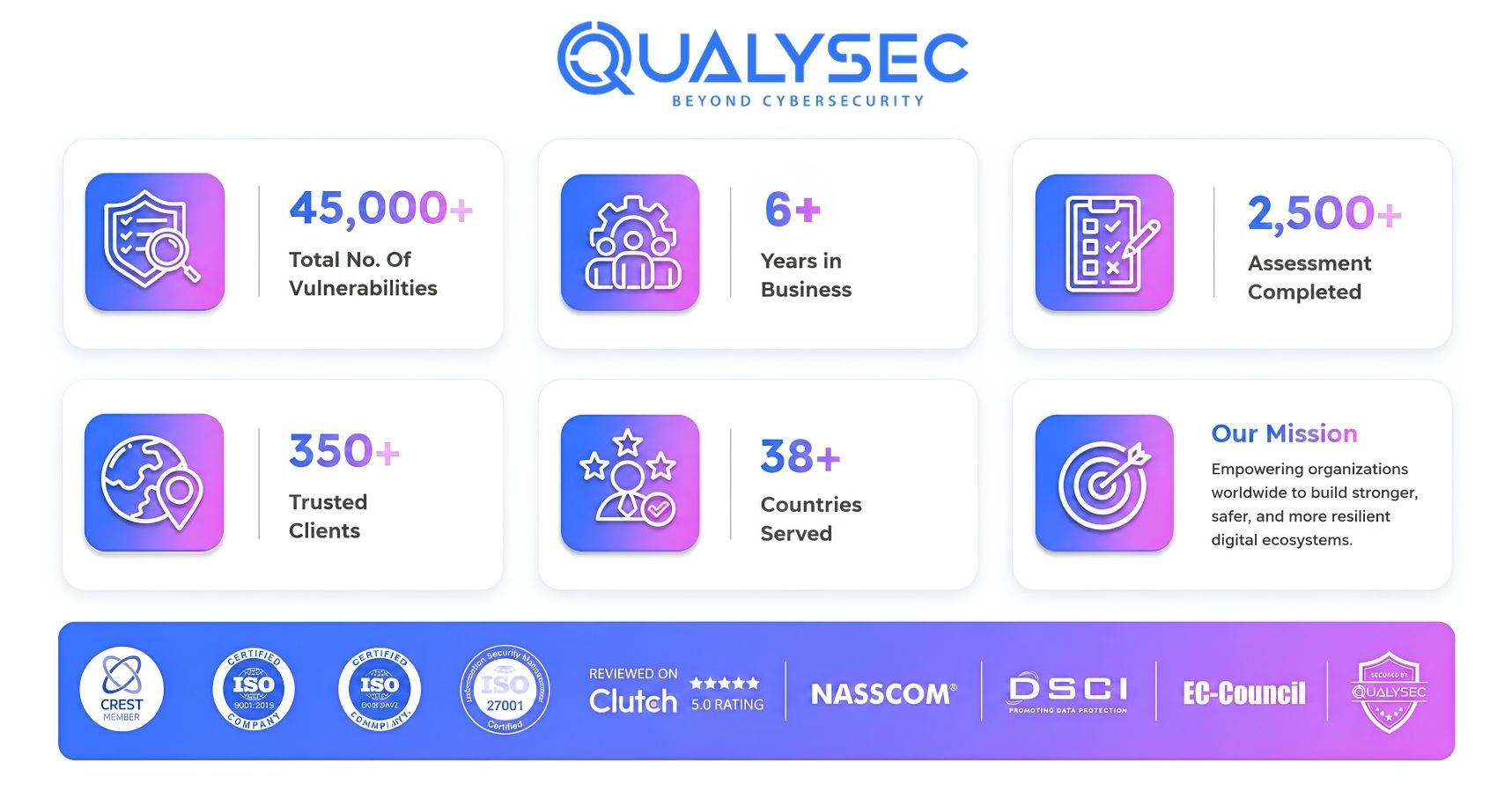
Qualysec Technologies has been in business for more than five years, working across web applications, mobile platforms, APIs, networks and cloud environments for clients ranging from early-stage startups to large enterprises. Over that time, the company built up more than 2,500 completed assessments and identified upwards of 45,000 vulnerabilities, a body of work that, going into the CREST review, existed mostly as institutional knowledge rather than a single, structured methodology.
Preparing for accreditation meant converting that experience into something repeatable and auditable.
We spent a long stretch just getting our own house in order, said Chandan Kumar Sahoo. That meant sitting down with senior testers and mapping out, step by step, how we actually approach an engagement, not the version we’d tell a client, the real version, warts and all, and then tightening whatever didn’t hold up to scrutiny. By the time CREST’s assessors got involved, we already knew where our gaps were, because we’d found most of them ourselves.
That internal audit surfaced smaller inconsistencies the team hadn’t fully appreciated, places where one tester’s reporting style differed meaningfully from another’s, or where evidence-handling practices worked fine day-to-day but weren’t written down anywhere a new hire could reference. Closing those gaps became as much a part of the accreditation work as anything CREST formally requested.
The Review Itself
Once Qualysec’s internal documentation and processes were in order, the formal CREST review examined the company’s methodology, sample work, tester qualifications and quality-control practices against the accreditation body’s published criteria. The review is designed to be difficult to game; assessors are specifically looking for evidence that stated practices are followed consistently, not just described well on paper.
The company’s engagement methodology, which draws on established frameworks including OWASP, NIST, PTES and OSSTMM, was assessed alongside its approach to reporting, client communication and remediation support, including its practice of offering a complimentary retest once a client has addressed identified vulnerabilities, to confirm the fix actually worked rather than assuming it did.
The team describes the review period itself as more demanding than expected, even after months of internal preparation. Assessors asked for sample engagement records, walked through how findings were reviewed before delivery, and probed how the company would handle edge cases, a scope disagreement mid-engagement, a client requesting a change after testing had already started, a finding severe enough to warrant immediate disclosure outside the normal reporting cycle. Having documented answers for situations that don’t come up on every engagement turned out to be just as important as the day-to-day methodology.
Why the Company Chose to Pursue It Now
Qualysec had been growing steadily for years without a formal accreditation of this kind, so the timing question is a fair one. The company points to two things: the scale it had reached, and where its client base was heading.
With more than 350 clients across 38-plus countries and an increasing share of engagements coming from regulated industries, such as healthcare, fintech, SaaS, e-commerce and BFSI among them, the company was fielding more procurement questions that a strong reputation alone couldn’t fully answer. Enterprise buyers and regulated organizations increasingly wanted independent proof of process, not just references and past work.
There was also an internal reason. Growing a testing team quickly, as Qualysec has over the past few years, tends to introduce small inconsistencies, different testers develop slightly different habits, and without a formal external benchmark, those differences can go unnoticed until a client happens to compare two reports side by side. Pursuing accreditation gave the company a forcing function to catch that drift before a client ever had reason to.
What Changes Now That the Accreditation Is Confirmed
With accreditation formally in place, Qualysec becomes eligible to be listed on CREST’s official Marketplace as a CREST accredited penetration testing company, a listing that gives prospective clients a way to independently veify the company’s status rather than relying solely on claims made on its own website or in sales conversations.
Internally, the company says the accreditation also changes how it plans to operate going forward, not just how it markets itself. CREST accreditation isn’t a one-time achievement that sits static once granted; maintaining it requires the underlying practices to keep holding up over time, which means the documentation and quality controls built during the application process aren’t going away now that the certificate has been issued.
That ongoing obligation is deliberate on CREST’s part. Accreditation bodies of this kind typically build in periodic reviews rather than issuing a credential once and stepping away, which means Qualysec’s documentation, quality controls and reporting standards will continue to be checked against the same bar going forward rather than being treated as a box checked once and forgotten.
- Formal listing on the CREST Marketplace as an accredited supplier
- Documented, repeatable methodology now embedded across every tester
- Stronger internal quality-review process ahead of every report going to a client
- A structured framework the company will need to keep the accreditation current
- Eligibility to compete for engagements that specifically require CREST-accredited vendors
What the Team Learned Along the Way
Beyond the certificate itself, both Sahoos point to the process as having sharpened the business in ways that go beyond compliance. Formalizing testing methodology meant newer hires now onboard against a clearer standard rather than picking up practices informally from senior colleagues. Quality-review steps that existed loosely are now a defined part of every engagement’s lifecycle, reducing the chance that inconsistent reporting slips through on a busy week.
The company describes the accreditation less as a finish line and more as a baseline it now has to keep clearing on every future engagement, a standard that, once documented and reviewed by an outside body, becomes harder to quietly let slip.
There’s also a cultural shift the leadership team mentions almost in passing: testers who went through the internal preparation say they now think about documentation differently. Where notes during an engagement were once treated as personal working files, they’re increasingly written with the assumption that someone outside the immediate team, a client, a future auditor, a new colleague picking up the account, might eventually need to read them and understand exactly what was done and why.
Qualysec Technologies further plans to keep refining its internal processes, invest further in tester training, and use the documentation built during the accreditation process as the foundation for how the company scales its testing team going forward.
About Qualysec Technologies
Qualysec Technologies is a cybersecurity company specializing in penetration testing, vulnerability assessment and security compliance services. Headquartered in Bhubaneswar, India, with a presence in Bengaluru and a growing international footprint, the company has worked with more than 350 clients across 38-plus countries in industries including BFSI, healthcare, fintech, SaaS, e-commerce and technology. Over 5+ years in business, Qualysec has completed more than 2,500 security assessments and identified over 45,000 vulnerabilities, combining manual, expert-led testing with structured methodology and evidence-based reporting. The company is now accredited by CREST and listed on the official CREST Marketplace as a security testing supplier, with Penetration Testing identified as its accreditation specialism.
Media Contact
QualySec Technologies
+91 8658663664
302, 3rd Floor, NSIC-IMDC Dharampad Bhawan, Mancheswar Industrial Estate, Bhubaneswar
Source :Qualysec Technologies
This article was originally published by IssueWire. Read the original article here.